Physics and statistics from zero从零开始的物理与统计
This page builds up each concept before using it, with one worked number example and one picture. Numbers come from the project's own files (the source path is listed under each).
本页在使用每个概念前先构建它,并给出一个用数字的例子和一幅图。数字来自项目自身的文件(每条下列出来源)。
From photons to a fitted spectrum从光子到拟合谱
XMM-Newton EPIC MOS is a CCD: each incoming X-ray photon is converted to a charge packet read out in an energy channel, giving a spectrum of counts vs channel. The instrument response turns photon energy into observed channel: the RMF (redistribution matrix file) maps true energy to detected channel, and the ARF (ancillary response file) gives the effective area vs energy. A spectrum file also carries BACKSCAL, the extraction-area scaling that converts counts to surface brightness. Background has two parts: the quiescent particle background (QPB, from closed-filter or blank-sky data) and the astrophysical sky background.
XMM-Newton EPIC MOS 是一个 CCD:每个入射 X 射线光子转换为一个电荷包,按能量通道读出,得到通道 vs 计数的谱。仪器响应把光子能量转换为观测通道:RMF(重分布矩阵文件)把真实能量映射到探测通道,ARF(辅助响应文件)给出能量函数的有效面积。谱文件还携带 BACKSCAL,即提取面积缩放,用于把计数转为表面亮度。背景有两部分:静止粒子背景(QPB,来自闭滤镜或空白天空数据)和天体物理天空背景。
Worked example: one run6 MOS spectrum (ObsID 0109270301, MOS2, region a032_040) has EXPOSURE = 26307.5 s and BACKSCAL = 35339748 in its SPECTRUM header (read with astropy, command on the howto page). If the source region area is \(A\) arcmin\(^2\), the surface brightness is roughly counts / (EXPOSURE \(\times\) BACKSCAL \(\times\) A).
用数字例子:一条 run6 MOS 谱(ObsID 0109270301,MOS2,区域 a032_040)的 SPECTRUM 头中 EXPOSURE = 26307.5 s,BACKSCAL = 35339748(用 astropy 读取,命令在 howto 页面)。若源区域面积为 \(A\) arcmin\(^2\),表面亮度约为 counts / (EXPOSURE \(\times\) BACKSCAL \(\times\) A)。
What kT and norm meankT 与 norm 的含义
A thermal plasma (APEC) spectrum is set by the temperature \(kT\) (in keV) and the emission measure. In XSPEC the APEC norm is \(10^{-14}/(4\pi D^2)\int n_e n_H\,dV\) (cm\(^{-5}\)), with \(D\) in cm. For \(kT=0.7\) keV, Z=1 (angr), unabsorbed APEC, the flux per unit norm is \(3.0247\times10^{-9}\) erg/s/cm\(^2\) in 0.5–2 keV and \(3.9497\times10^{-9}\) erg/s/cm\(^2\) in 0.1–10 keV (ratio 0.766). So a SrcApec norm of \(3.19\times10^{-7}\) (the a=20' annulus) corresponds to a 0.5–2 keV flux of \(3.19\times10^{-7}\times3.0247\times10^{-9} = 9.6\times10^{-16}\) erg/s/cm\(^2\) before area normalisation.
热等离子体(APEC)谱由温度 \(kT\)(单位 keV)和发射量度决定。在 XSPEC 中,APEC norm 是 \(10^{-14}/(4\pi D^2)\int n_e n_H\,dV\)(cm\(^{-5}\)),\(D\) 单位 cm。对 \(kT=0.7\) keV,Z=1(angr),未吸收 APEC,每单位 norm 的通量在 0.5–2 keV 为 \(3.0247\times10^{-9}\) erg/s/cm\(^2\),在 0.1–10 keV 为 \(3.9497\times10^{-9}\) erg/s/cm\(^2\)(比值 0.766)。所以 a=20' 环带的 SrcApec norm \(3.19\times10^{-7}\) 对应未归一化前的 0.5–2 keV 通量 \(3.19\times10^{-7}\times3.0247\times10^{-9} = 9.6\times10^{-16}\) erg/s/cm\(^2\)。
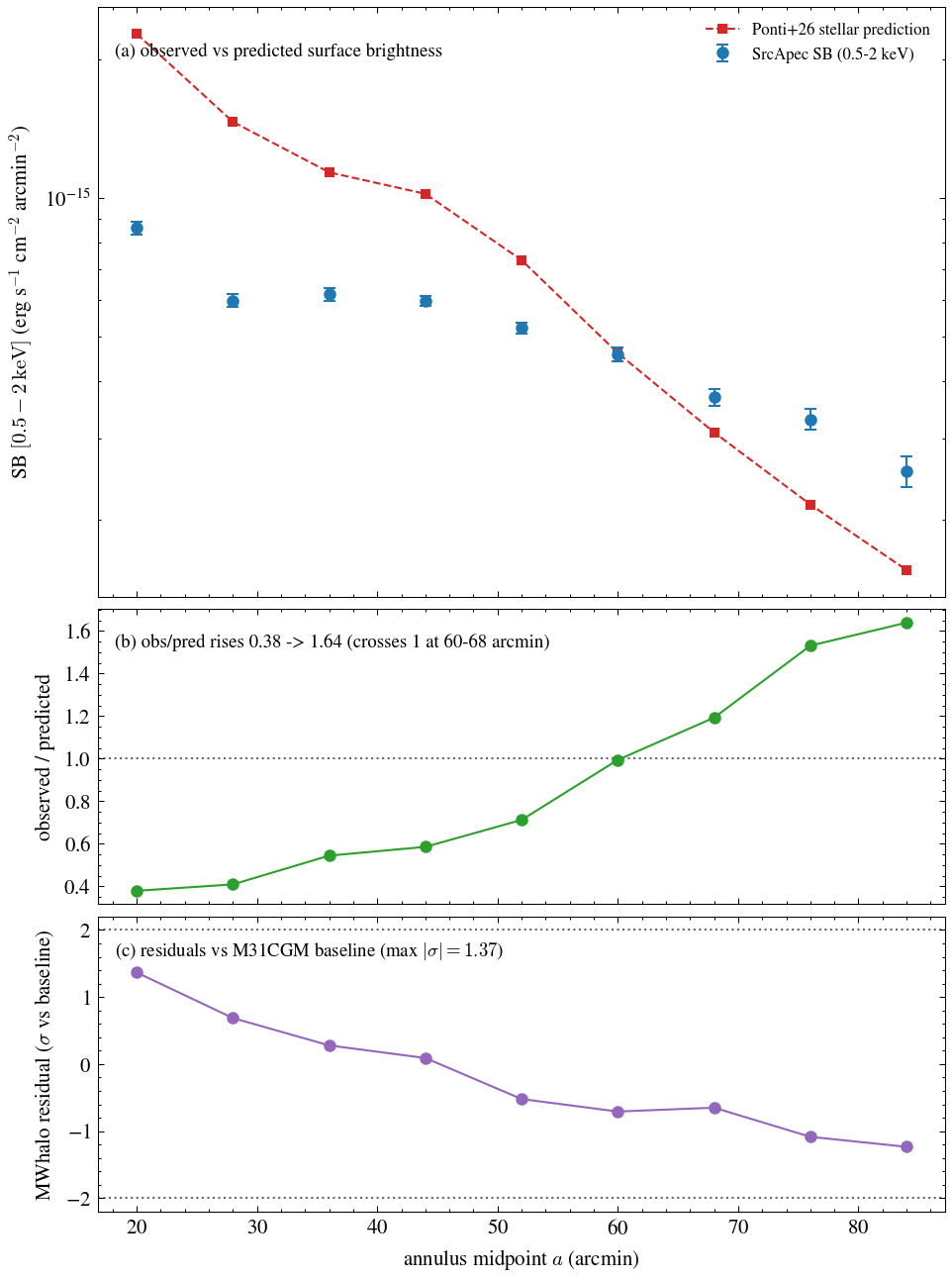
Animation: add a constant sky level to a stellar profile动画:给恒星剖面加上一个恒定天空水平
Foreground–source degeneracy前景–源退化
A foreground (LB + MWhalo + CXB) and an M31 SrcApec component can trade flux: making the foreground brighter lets SrcApec's norm shrink, and vice versa, with almost the same \(\chi^2\). The errors from a fit with the foreground frozen (conditional \(\Delta\chi^2=1\)) are far too small — after R008, profile-likelihood errors with the foreground free are required. The figure shows why: profiling the foreground widens the norm error by more than a factor of two.
前景(LB + MWhalo + CXB)与 M31 SrcApec 成分可以互换通量:前景越亮,SrcApec 的 norm 越小,反之亦然,\(\chi^2\) 几乎不变。前景冻结拟合得到的误差(条件性 \(\Delta\chi^2=1\))远小于真实误差——R008 后,要求用前景自由的 profile-likelihood 误差。下图说明原因:对前景进行 profile 会将 norm 误差扩大两倍以上。
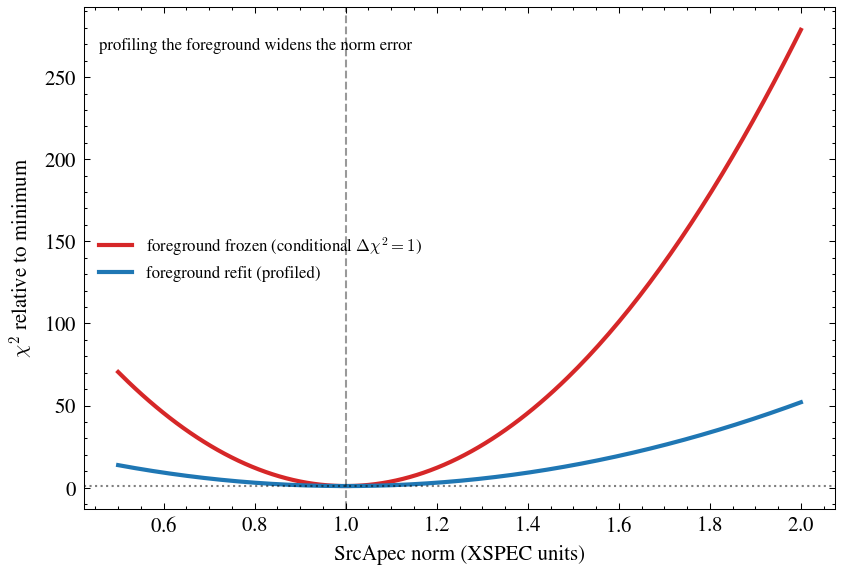
Animation: chi-square against the norm, foreground frozen vs refit动画:卡方 vs 标准化量,前景冻结 vs 重拟合
The stellar-floor prediction恒星底板预测
The unresolved-stellar floor is \(L_X\) per stellar mass times stellar mass: \(L_X = (L_X/M_*)\times M_*\). Ponti+26 give \(L_X/M_* = 1.05\times10^{28}\) erg/s/\(M_\odot\) (all stars) or \(6.9\times10^{27}\) (bright resolved point sources removed), 0.1–10 keV, from a fixed \(kT=0.7\) keV, \(Z=Z_\odot\) APEC fit to the western Galactic hemisphere. For M31, \(M_*\) comes from WISE \(W1\) via \(M/L_{W1}\approx 0.6\) (Telford+2020, 0.4 dex spread).
未解析恒星底板是每恒星质量的 \(L_X\) 乘以恒星质量:\(L_X = (L_X/M_*)\times M_*\)。Ponti+26 给出 \(L_X/M_* = 1.05\times10^{28}\) erg/s/\(M_\odot\)(所有恒星)或 \(6.9\times10^{27}\)(移除亮已解析点源后),0.1–10 keV,来自对西银河半球固定 \(kT=0.7\) keV、\(Z=Z_\odot\) APEC 的拟合。对 M31,\(M_*\) 由 WISE \(W1\) 通过 \(M/L_{W1}\approx 0.6\) 得到(Telford+2020,0.4 dex 离散)。
Worked example: if an annulus has stellar mass \(M_* = 10^9\,M_\odot\), the bright-removed stellar floor predicts \(L_X = 6.9\times10^{27}\times10^9 = 6.9\times10^{36}\) erg/s (0.1–10 keV). Compare with the observed diffuse luminosity to see whether a residual remains.
用数字例子:若一环带恒星质量 \(M_* = 10^9\,M_\odot\),则亮源移除后的恒星底板预测 \(L_X = 6.9\times10^{27}\times10^9 = 6.9\times10^{36}\) erg/s(0.1–10 keV)。与观测弥散光度比较,看是否还留有残余。
Survey map to spatial template; the sky pedestal调查图到空间模板;天空底座
A WISE mosaic becomes a spatial template by projecting its pixel values onto each MOS window (annulus). But a raw mosaic carries an off-disk sky level (the pedestal): B026 measured W1 off-disk = 6.87 DN, while on-disk medians are 12.92 (a=32–48'), 9.71 (48–64'), 8.08 (64–80'), 7.38 (80–96'), 7.08 (96–112') — the pedestal is 53–97% of the W1 template, and W4dust is \(\approx\)99% pedestal.
Why the pedestal does not fake a young component: adding a constant to every pixel of a template only moves the constant term \(C\) in the fit — it cannot change the amplitudes \(A_\mathrm{old}\) or \(A_\mathrm{young}\). With a free, unbounded constant the fit is shift-invariant: \(\sigma(A_\mathrm{old})\) and \(\sigma(A_\mathrm{young})\) are identical for raw and net templates; only the correlation \(\mathrm{corr}(A_\mathrm{young}, C)\) moves (from −0.9996 to −0.02…−0.13, R022). So R006 “mixed old+young not identifiable” is caused by the narrow W4dust range across windows, not by the sky pedestal (R022 narrows R013). “Old beats young by \(\Delta\chi^2=770\)” compared W1+pedestal against an essentially flat template, so “constant \(\to\) 0 with W1” is not evidence against a flat component. V6 rebuilds with net (sky-subtracted) templates.
WISE 马赛克通过把像素值投影到每个 MOS 窗口(环带)成为空间模板。但原始马赛克带有一个场外天空水平(底座):B026 测得 W1 场外 = 6.87 DN,而盘中中位数为 12.92(a=32–48')、9.71(48–64')、8.08(64–80')、7.38(80–96')、7.08(96–112')——底座是 W1 模板的 53–97%,W4dust 约为 99% 底座。
为什么底座不会伪造一个年轻成分:给每个像素加上同一个常数,只会把拟合中的常数项 \(C\) 平移,而不能改变 \(A_\mathrm{old}\) 或 \(A_\mathrm{young}\) 的振幅。在带自由无界常数的情况下,拟合是平移不变的:\(\sigma(A_\mathrm{old})\) 和 \(\sigma(A_\mathrm{young})\) 对原始模板与净模板完全相同;只有 \(\mathrm{corr}(A_\mathrm{young}, C)\) 发生变化(从 −0.9996 到 −0.02…−0.13,R022)。因此 R006 “混合 old+young 不可辨识”的成因是 W4dust 窄范围,而非天空底座(R022 收窄了 R013)。“old 胜 young,\(\Delta\chi^2=770\)” 把 W1+底座与一个基本平坦的模板相比较,所以“constant \(\to\) 0 with W1”不是反对平坦成分的证据。V6 用净(减天空)模板重建。
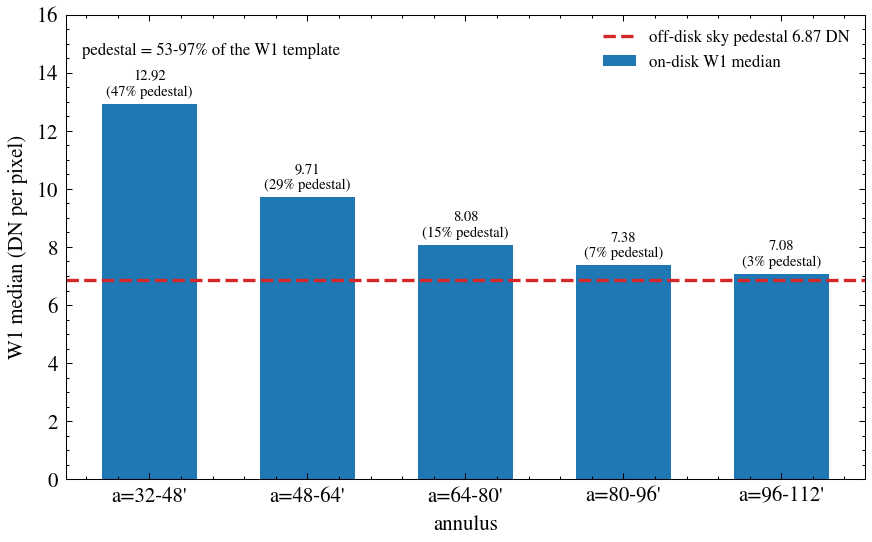
The same pedestal logic applies to the one-foreground story on the state page: a constant foreground level cannot be separated from a constant term in the fit, which is exactly why the disk soft floor and the halo-field 0.7 keV term can be confused.
同样的底座逻辑也适用于状态页上的单一前景故事:恒定前景水平在拟合中无法与恒定项分开,这正是为什么圆盘软底板和晕场 0.7 keV 项会被混淆。
Newest source read: cognition-os/08_RUNNING.md revision 49, updated 2026-11-05 03:56 EST; 07_REVISION_LOG.md R054–R131 and 04_DECISION_LOG.md D26–D30 read in full.
最新读取的来源:cognition-os/08_RUNNING.md 修订版 49,更新于 2026-11-05 03:56 EST;07_REVISION_LOG.md R054–R131 与 04_DECISION_LOG.md D26–D30 已全文读取。